Friday, 31 July 2020

How to Land an Internship: The Ultimate Guide

While the college landscape has changed this year, what you make of it doesn’t have to. Over the last few months, companies may be starting to notice the positive impacts working remotely has made on their teams. As the new school year approaches, you may be thinking how you can go the extra mile.

Even though some businesses may be working more remotely, that doesn’t mean your chances of getting an internship are hindered. To test the waters of your career before you graduate, put yourself out there, and land an internship that could build your career, and your budget. 

Start the Internship Search

First things first, search for the internship you’d like to hold. While you may have an idea of what you’d like to do after college, keep your internship choices broad. Cast your applications far and wide — you may find a passion for something other than you ever thought you would. 

Build Your Resume and Cover Letter to Impress

Second, start prepping for the perfect first “virtual” impression. Tailor your resume to the job your applying to and double-check that there aren’t any mistakes in your resume. Along with that, prep a stellar cover letter that will knock them out of the park. Make sure to showcase your genuine interest in their company. 

Impress From Day One

Now you may have landed an interview, make it the best interview yet. Research the company you’re interviewing with. Find out how they got started, how far they’ve come, and who the key players of the industry are. If the interviewers release their name before the interview, research each individual and their impacts on the company. 

You Got the Job — Now Showcase Your Skills 

Now you’ve landed the job and your ready to make the most of this experience. Start by impressing your team the first day on the job, and grow your network. During the first week, go around the office and introduce yourself to everyone you can. Over time, you may grow professional connections that form into career mentors. Ensure to keep these relationships as you grow your career. 

Check out our infographic below for more tips and tricks to land your dream internship that actually pays:


7 Tips For Landing Your Dream Internship (That Pays!)


from
https://addicted2success.com/success-advice/how-to-land-an-internship-the-ultimate-guide/

Thursday, 30 July 2020

How Much Sleep Do You Need? The Sleep Routines of 50 Ultra Successful People

How much sleep do high-achieving CEOs, entrepreneurs, and artists need to fuel their ambitions? It’s well known that a good night’s sleep has lots of benefits, from lower stress and better emotional resilience, to healthy immune systems and lower risk of certain diseases. Uninterrupted sleep usually makes for sharper focus and concentration, too. Surely that means that getting a good nights’ sleep should be high on the agenda of anyone aiming at success

When it comes to highly successful people, it seems that some don’t value sleep as highly as the doctors recommend. Online Mattress Review have created a new infographic, The Sleep Routines of Successful People, which shares the sleeping hours and evening activities of famous achievers. From artists, entertainers, and sportspeople, to leaders in business and politics, it seems that, like the rest of us, priorities can differ when it comes to how time is best spent.

Some of the most famous and powerful people seem to get by on very little sleep. America’s 45th President, Donald Trump works until after midnight, and gets only 3 hours of sleep. Also in the 3-hours club is the famously grumpy celebrity chef, Gordon Ramsay, who works until 2am. Lack of sleep certainly hasn’t stopped either from being incredibly successful and well-known. 

“Sleep is the best meditation.” – Dalai Lama

At the other extreme, actress Kim Kardashian and environmental activist Greta Thunberg make unlikely bedfellows, with each getting a refreshing 9 hours of sleep per night. Their evening activities differ though, with Kardashian working until late and Thunberg relaxing with friends and good books. Highly successful people are able to find the routine that works best for them.

Check out the infographic below to see the sleep routines of 50 highly successful people:


from
https://addicted2success.com/success-advice/how-much-sleep-do-you-need-the-sleep-routines-of-50-ultra-successful-people/

Wednesday, 29 July 2020

How to Create Thriving Opportunities During Unfortunate Times

If you’d like to learn how to thrive during uncertain times so you can always find ways to be successful, sign up for the free 90-Day Master Class hosted by the founder of Addicted2Success.com, Joel Brown.


The current situation we are all dealing with in the world has had an unprecedented impact on businesses, both new and established, across every industry imaginable. From tourism and travel to retail and even e-commerce, business is down and there is an uncomfortable sense of uncertainty across the world.

There are always going to be unfortunate world events that we have to deal with head-on, but a global pandemic like we are currently experiencing is unchartered waters for most business owners and entrepreneurs.

One of my companies creates direct-to-consumer beauty brands and we launched a new brand amid the global pandemic. Many said that launching a new brand during the pandemic was very risky.

Guess what happened? It took off. It exploded out of the gate and scaled faster than other brands that launched in what many experts would say, were more stable economic times. We made sure to check-off several boxes — ones that I knew would lead to the success we experienced.

This formula doesn’t only apply to e-commerce brands. It actually applies to any new business. While most are playing it safe and laying low, there is a huge opportunity to introduce new products or services to the market. 

Here are a few things to consider if you decide to take the leap:

1. Identify a Need, Want, or Desire with High Demand

The brand we launched was an at-home kit that allows consumers to get salon-quality nails at home. One of the most complained about topics across social media was nails — or lack of options since most salons were ordered to close.

As it became clear that salons wouldn’t be opening for some time, we decided to launch a home-kit. There was a clear need, want, and desire. All you had to do was look on social media and it was very obvious that if we brought a solution to the market, we would have willing and able buyers.

The demand was there and the price-point was more affordable than the salon. We created a win-win situation for the consumer. They were able to do their nails and save money. There are always going to be needs and wants during unforeseen times. Identify them and you will face opportunity directly in the face.

“In the middle of difficulty lies opportunity.” – Albert Einstein

2. Find a Way to Place Your Offer Directly in Front of Your Target Audience

There is one aspect of the global pandemic that gave many businesses a major advantage. They could easily market to their ideal customer through online marketing.

From email marketing to paid social media and influencer marketing — consumers were at home and a large percentage of them were on their computer or had their mobile device glued to their hands.

With our brand, we knew that we could run highly targeted social media campaigns and place our offer right in front of those that were craving a solution for their nail problem. The same logical thinking was utilized by many businesses.

Let’s take the restaurant industry for example. Many were forced to stop serving and sitting guests, so they had to convert to take-out and delivery only. Many that didn’t focus on this prior immediately turned on social media ads and pushed local consumers to download their own app or encouraged them to order via platforms like Uber Eats and Postmates.

3. Show Empathy in Your Marketing Message

In our situation, we more than likely could have just run straight ads with the message of, “Get your nails done” and received some interest. But we decided to focus on showing empathy while also presenting the consumer with a solution.

The pandemic impacted people differently — from losing loved ones to the virus to being laid off — it required a softer message for that initial touch-point. I am constantly analyzing D2C marketing and messaging and some of the most successful campaigns I have seen during this crisis displayed some level of empathy in the message.

I feel that a lot of brands assumed that consumers would simply stop spending money during the pandemic, which wasn’t the case at all. Some brands did slow down advertising, which created another opportunity — lower ad costs and media buys.

It honestly couldn’t be easier. A simple approach along the lines of, “Hey, we know times are crazy and there is a worldwide sense of uncertainty, and we also know you miss the little things like getting your nails done…”

Brands, especially new ones, were presented with an opportunity to make a strong connection with consumers. Life was slowed down a bit. People weren’t in such a rush because they literally had nowhere to go.

This was an opportunity to let them know you care and establish that relationship. This actually relates directly to my final point below.

“There is only one boss. The customer―and he can fire everybody in the company from the chairman on down, simply by spending his money somewhere else.” – Sam Walton

4. Operate and Build with Post-Tragedy Scale in Mind

I’ve seen a lot of brands surface during the pandemic, and I am willing to bet when I check on them a couple of months down the line they will be long gone. Why? Because they are only focused on the “now” and have zero vision for the future.

This is the wrong way to approach launching a new opportunity — pandemic or not. One of the reasons I stressed building a strong initial relationship with the consumer is because of long-term scale and growth.

If you connect with a consumer during a difficult time and build a meaningful relationship by providing them with a product or service that helps them — solving a problem or taking their mind off the current situation — they are going to be very brand-loyal moving forward.

With our brand, we are solving a problem caused by the pandemic and shutdown, but we are also providing convenience and a product that has the potential to thrive in a “normal” world. Someone that is introduced to the brand during these times and has a pleasant experience is likely to be a repeat customer.

The brands that are only focused on making a quick buck will be scrambling when things settle down and consumers return to their normal activities and routines. Those that had post-pandemic scale in mind will continue to grow and thrive in the future.

How do you create opportunities during uncertain times? Share your thoughts with us below!


from
https://addicted2success.com/success-advice/how-to-create-thriving-opportunities-during-unfortunate-times/

Tuesday, 28 July 2020

It’s Time to Stop Abdicating and Own Your Amazement

If you’d like to learn how to stop playing small so you can get anything you want out of life, sign up for the free 90-Day Master Class hosted by the founder of Addicted2Success.com, Joel Brown.


My favorite pastime is to sit outside a cafe, coffee in hand, watching people move, interact, and be with themselves. It is also what I do for a living. I am a listener, watcher, and instigator. My children know that I can easily strike up a deep conversation with a complete stranger and know the person’s full life story in less than 20 minutes. My children marvel at how I know a waitress at a favorite restaurant or barista at a local coffee shop. 

I have a lot of pet peeves, and one of them is when people play small. I could tell you dozens of stories of witnessing kids as young as 5 and humans as old as 92 who abdicate the brilliance, beauty, and amazement of their own beings. I’ve taken up the cause and dedicate my life to breaking that pattern.

“There is no passion to be found playing small – in settling for a life that is less than the one you are capable of living.” – Nelson Mandela

The truth about humility

Decades ago, I heard the best definition of humility. True humility is to be no more and no less than that which you are in your own right. Whether it is instinctive or learned, most of us know how to exist being “no more.” Whether it is based on the need for safety, security, or one million other reasons, playing small or playing it safe is woven into the fabric of most of our beings. Being “no less” is where the juicy parts flow. 

Take a moment, and let’s do a personal assessment together. Find a quiet space where you can be in a comfortable position. Bring intentionality into your body. If you are sitting, place the soles of your feet on the floor about hips distance apart. Feel the soles of your feet underneath you and feel the ground underneath the soles of your feet. 

Lift through the top of your head, not creating strain but intentionally stretch. Bring the palms of your hands to your knees or thighs and close your eyes or leave them open. If you leave them open, allow them to gaze softly down the bridge of your nose about three feet in front of you. Afterwards, make sure to breathe. Matter of fact, take a few breath cycles of breathing in and breathing out, as you do that say to yourself, “Breathing in I know that I am breathing in, Breathing out I know that I am breathing out.” 

Repeat those words with each cycle, perhaps making them shorter as you keep on with the breathing, “Breathing in, Breathing out,” or even “In, Out.” 

Notice your body. Allow yourself to be aware of how your body feels when you’re breathing. When you begin feeling more present in the moment, take an even deeper breath and ask yourself, “How do I want to show up in life?” It is okay if thoughts and your mental being want to answer. Also listen for deeper wisdom coming from your heart and body.

If you have extra time, reflect on where you have abdicated, sold yourself short, and played small. My hope for you in these moments is that those critical inner spaces don’t override just allowing yourself to be informed, try to hold off judgement and criticism. Take some longer breaths if you feel those sensations creeping into your being.

“If you hear a voice within you say ‘you cannot paint,’ then by all means paint, and that voice will be silenced.” – Van Gogh 

For example, I abdicated several spaces in my life. Professionally, I allowed others to always be the “expert.” When I stepped into the space of owning my own strengths, I allowed myself to be no less. I set my sights on what I wanted to accomplish, took the necessary steps, and I’m reaching high for my own dreams and goals

What’s the very next step you can take? What is one thing you could do today, this week, or this quarter? Let yourself be no less than who you really are. Be more intentional about feeling present in your body and in the now. Release regret, acknowledge if there is any fear or doubt, and step forward.

Lastly, take a seat. Bring the backs of your hands to the tops of your knees. I want you to say “I am an AMAZEMENT,” two times in a regular voice, two times in a whisper, one time quietly to yourself, and one time as loud as you want. Bring your thumb across the pad of each finger as you speak the words and press down. Thumb to index finger, “I.” Thumb to middle finger, “AM.” Thumb to ring finger, “AN.” Thumb to pinky finger, “AMAZEMENT.” And repeat. Do this for the next couple weeks, notice the difference. Live and thrive in the knowledge of your own competency, your own amazement, be no less!

Let us know in the comments what you think once you try the technique described above!


from
https://addicted2success.com/life/its-time-to-stop-abdicating-and-own-your-amazement/

Monday, 27 July 2020

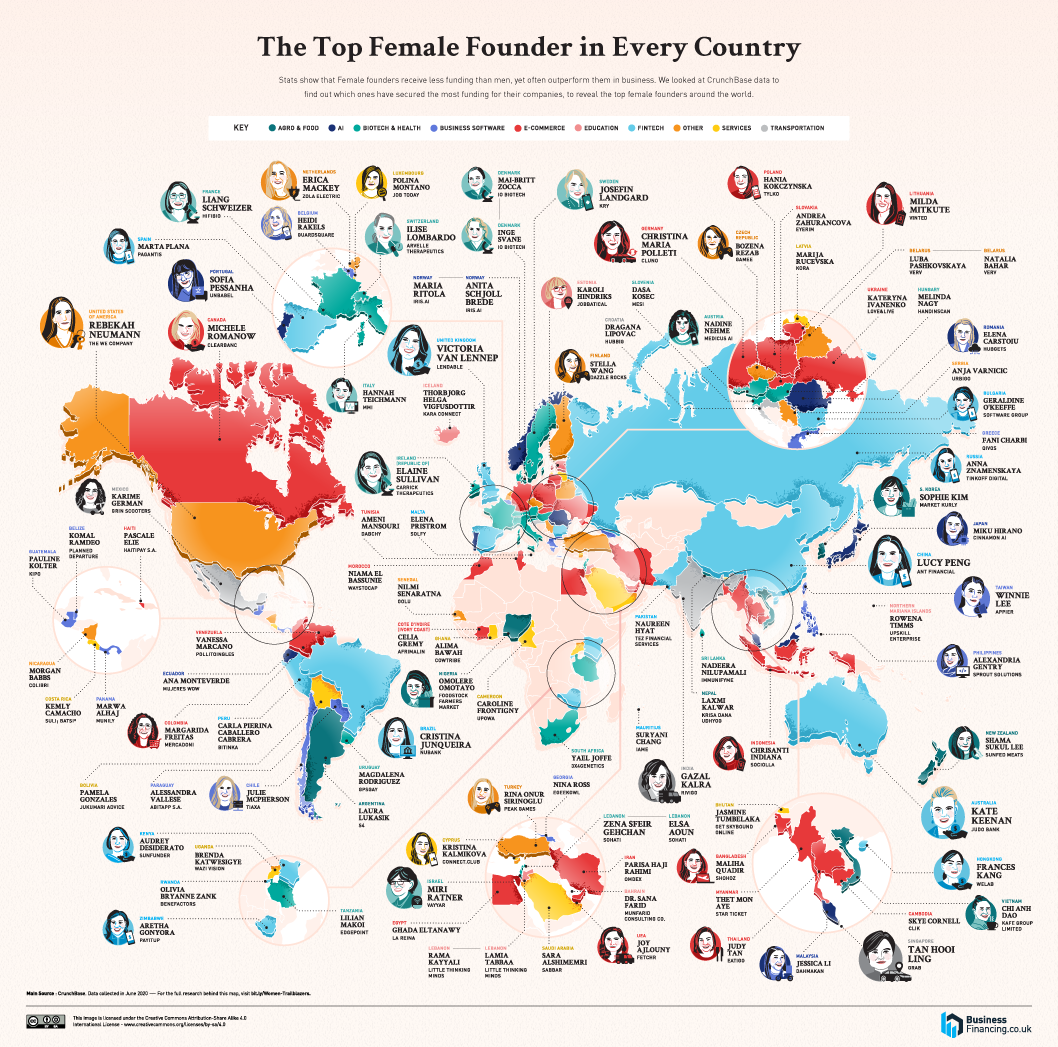
Women Trailblazers: The Most Successful Female Founder in Every Country

If you are a female entrepreneur, it’s natural to feel like the odds are against you. After all, there continues to be a significant bias towards a male-leadership model, and investors still tend to be more cautious in their response to pitches from women.

You shouldn’t be put off by nay-sayers, though. If you’ve got a great business idea, it’s really worth persevering to make it happen. Despite the fact that only 15% of venture capital is invested in them, women-led businesses consistently offer a better return on that investment.

Women entrepreneurs out-perform their male counterparts in terms of revenue, in part because their motivations tend to be less profit-driven. With a more meaningful, customer led approach, greater interest in corporate social responsibility, and collaborative working culture, they are primed for greater overall success.

To celebrate the impressive achievements of women who are world leaders in startup business, BusinessFinancing have gathered data on the top female founders from country to country around the world. 

Top 5 Women Startup Founders Around the World

The data shows that startup success is possible across a wide range of industries, with particular success in fintech and e-commerce. The self-made women with the highest levels of finance are spread across the continents. Lucy Peng’s online finance company Ant, which is based in China, has achieved a massive $22 billion in funding. No wonder she was named Forbes’ 35th most-powerful woman in 2016.

Hot on Peng’s heels is Rebekah Neumann, whose US-based real-estate company The We Company, which specialises in establishing collaborative work spaces, achieved a significant $19.5 billion. With the third highest funding of $9.9 billion, Singapore’s Tan Hooi Ling has revolutionised transportation with her Grab app, which connects drivers and passengers. 

Innovating fintech to offer more personal finance services to smaller businesses, and creating a fairer personal lending platform, Kate Keenan (Judo Bank – Australia) and Victoria van Lennep (Lendable – UK) achieved similar funding levels of $1.4 and $1.2 billion, respectively.

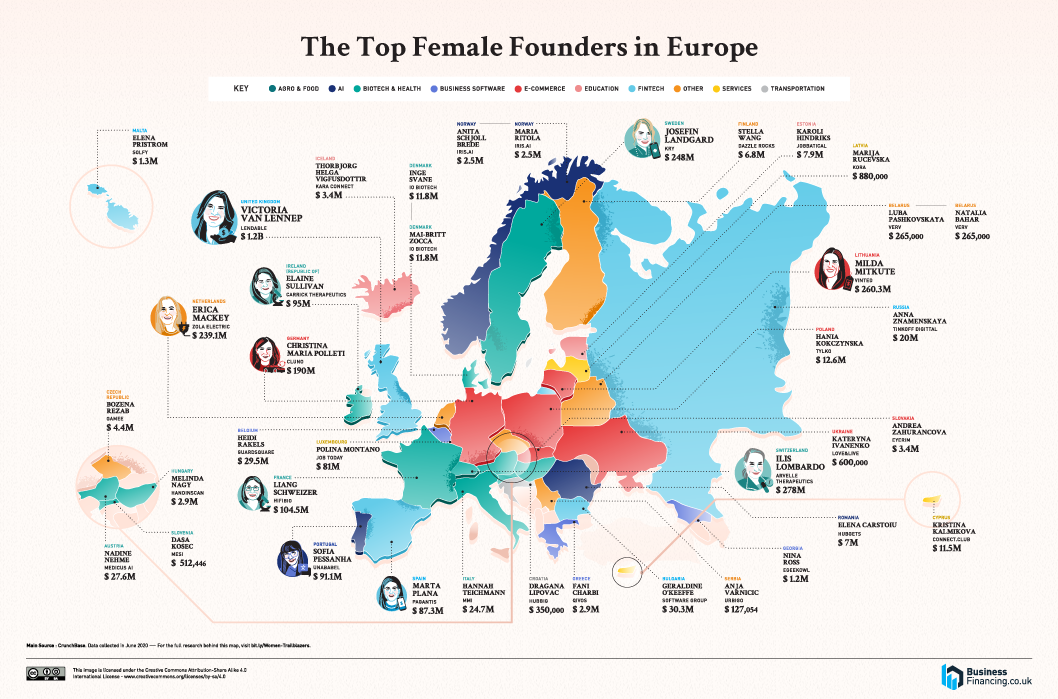
Top Women Founders in Europe

In addition to Victoria van Lennep’s huge success in fintech with Lendable, the biotech and health industry is a thriving field for startups in Europe. Switzerland’s Ilise Lombardo has raised a $278 million fortune for the biopharmaceutical company Arvelle Therapeutics, specialising in treatments for  disorders of the Central Nervous System (CNS). In Sweden also, Josefin Langerd got $348 million for KRY’s healthcare and digital health services.

Lifestyle systems and wellness are flourishing fields for women entrepreneurs in eastern europe. Anja Varnicic raised an impressive $127,054 for her mini indoor garden enterprise in Serbia, and Belarussians Luba Pahkovskaya and Natalia Bahar each raised $265,000 each for their wellness and fitness app, Verv. 

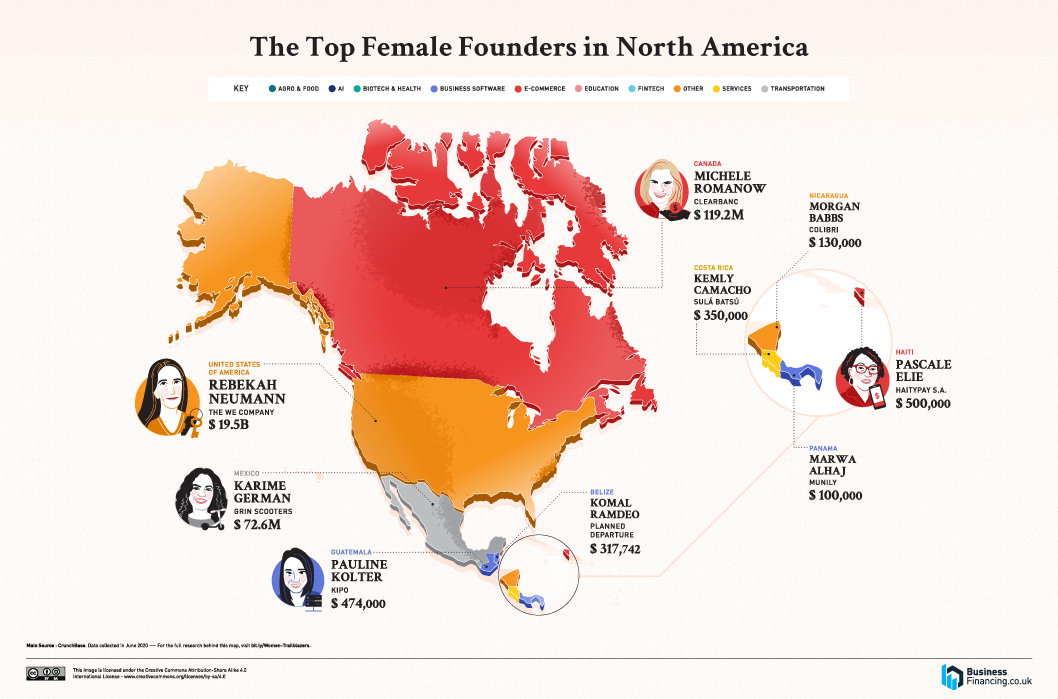
Top Women Founders in North America

Women are making it big with e-commerce and business software in North AMerica. After Rebekah Neuman, Canada’s Michelle Romanov has raised $119.2 million for Clearbanc. The data also shows that community-focused startups are financially viable, with $100,000 raised by Marwa Alhaj in Panama for her security and communications software company, and $130,00 by Morgan Babbs, who is making a difference to low income houses with her solar solutions company, Colibri, in Nicaragua.

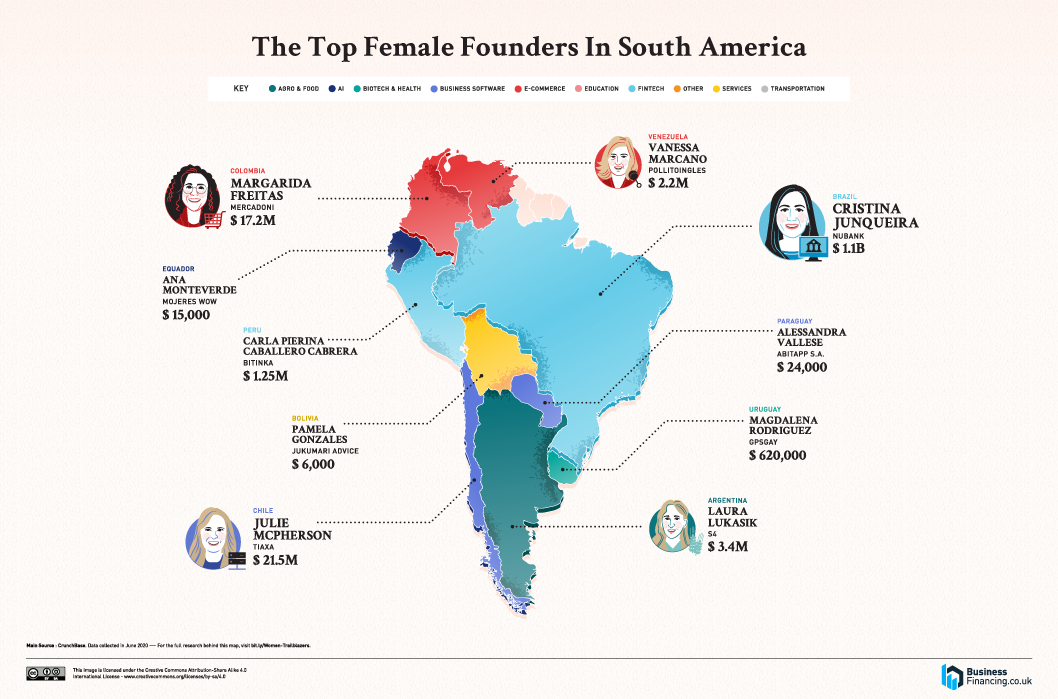
Top Women Founders in South America

Brazil’s Cristina Junqueira is pretty inspirational. Not only did she raise $1.1 billion for her finance company, Nubank, but she is also a vocal advocate for gender equality and inclusion in the world of business and finance. She clearly understands the benefit of being forward-thinking and how embracing diversity will attract new talent. No wonder she was listed twice as one of Forbes’ most powerful women!

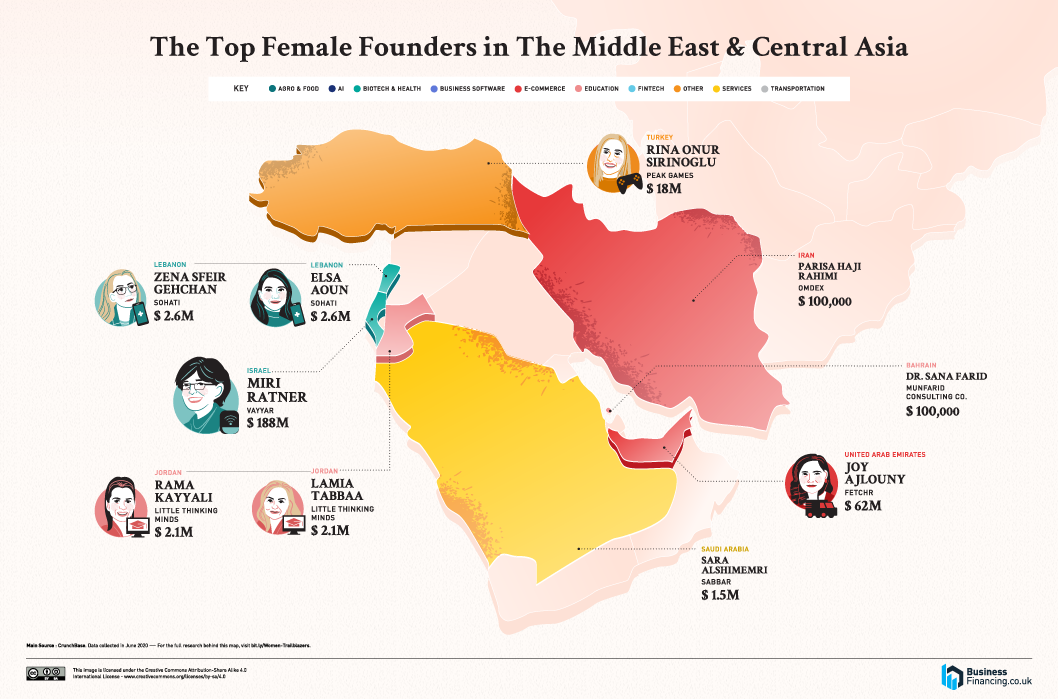
Top Women Founders in the Middle East & Central Asia

There’s a lot going on for women entrepreneurs in this part of the world, with start up founders doing well in the fields of education (Lamia Tabbaa and Rami Kayyali at Little Thinking Minds in Jordan) and gaming (Rina Onur Sirinoglu at Peak Games in Turkey), as well as the usual finance and e-commerce. 

Making a significant difference to the field of biotech and health, Miri Ratner has raised $188M as co-founder of Yayar. Yayar developed a sensor that was initially intended as an early detection system for breast cancer, but has since found applications in robotics, intelligent vehicles, and security systems. 

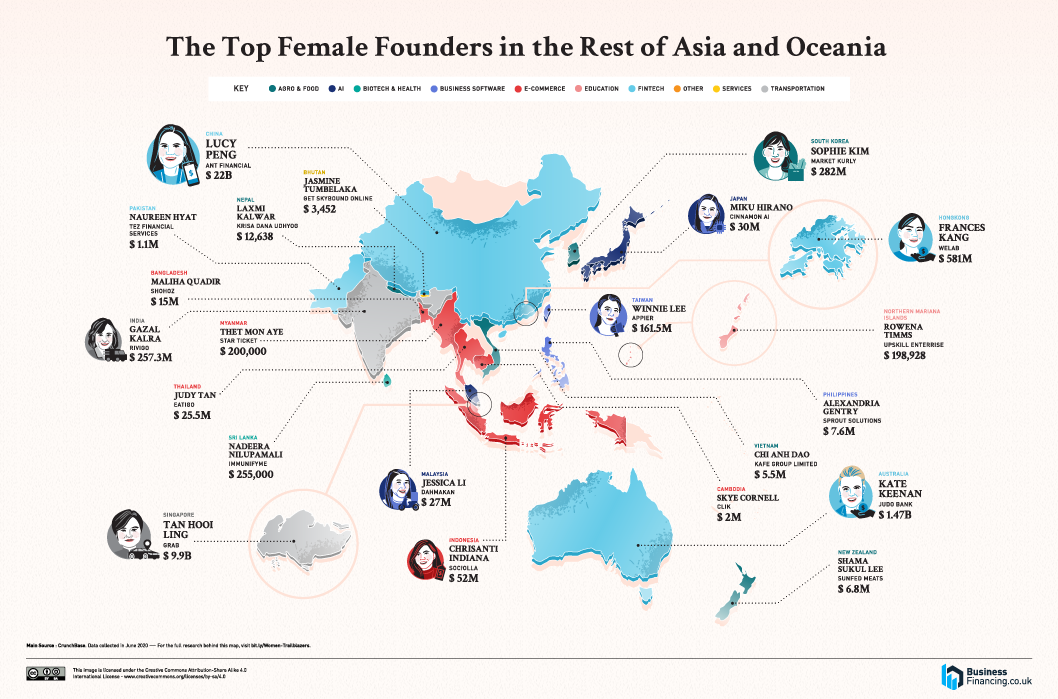
Top Women Founders in the Rest of Asia & Oceania

Of the top ten financial successes in this region, half were in the fields of fintech and e-commerce. As well as frontrunners Lucy Peng (China) and Kate Keenen (Australia), Japan’s Miku Hirano has made great waves with her AI company, Cinnamon. Hirano was inspired to create innovative solutions to improve working culture after the birth of her child. She envisioned how AI assistance in cumbersome tasks could facilitate a healthier future for future generations.

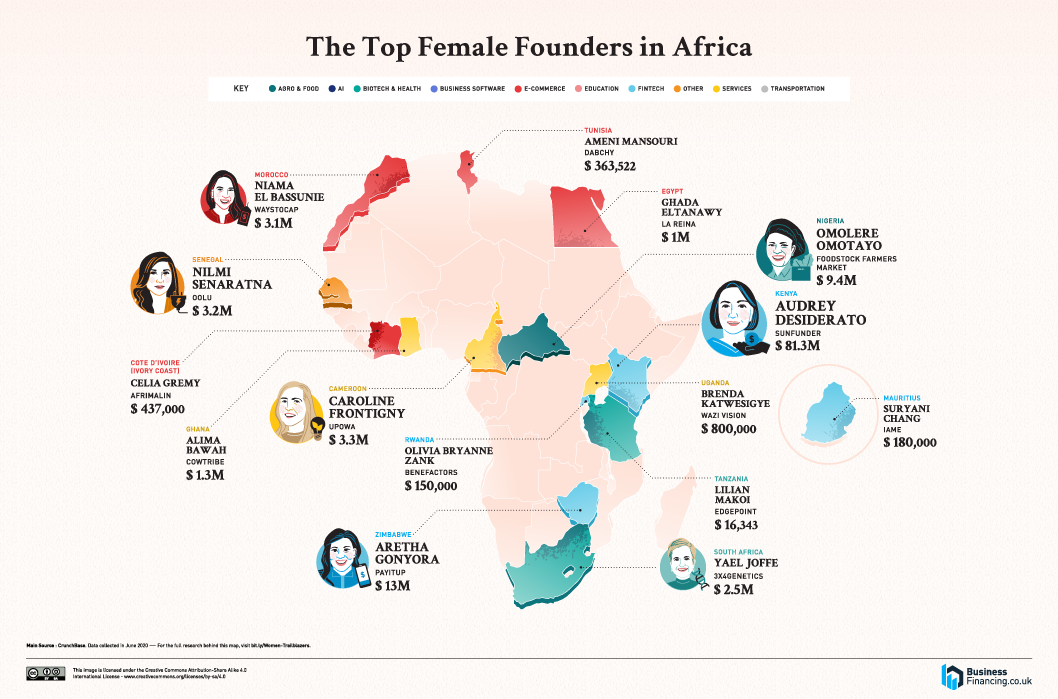
Top Women Founders in Africa

Of the 15 African countries included in the study, women have made strides across a wide range of industries. As well as the usual fintech and e-commerce, various services are focused on helping people in the community access health care, energy, and resources.

Audrey Desiderato has achieved great success, raising $81.3 million for her solar-energy Kenyan company, SunFunder, while Alima Bawah’s Cowtribe made $1.7 million to provide farmers with animal vaccines in Ghana, and Brenda Katwesigye raised $800,000 for WaziVision to provide recycled glasses to people in Uganda.

From finance to farming, there’s more to building a successful startup than money. Women entrepreneurs have a talent for seeing how business affects people, and that makes a big difference.


from
https://addicted2success.com/entrepreneur-profile/women-trailblazers-the-most-successful-female-founder-in-every-country/

Sunday, 26 July 2020

What You Give and Receive Through Mentoring

I’ve always believed that the relationships and lasting connections formed while mentoring are the ultimate reward. On one hand, a mentee gets the direct benefit of advice from a seasoned professional and can make career strides that might not have otherwise been possible without guidance. The pride of watching a junior grow and thrive is incredibly fulfilling; after all, it’s been well-established that it’s better to give than to receive.

However, this doesn’t mean mentees are the only ones rewarded for being part of a mentoring relationship. Mentors find that the more they give to their protégés, the more they get back as well. Mentoring is a two-way street, and being an effective teacher to a younger colleague will allow you to receive just as much as you give.

What You Give: Better Communication Skills

Mentors can do no better than to help their students develop strong communication skills. The world is driven by interpersonal relationships, and knowing how to connect and engage meaningfully with others is an ability that benefits everyone, no matter where they are in their career.

Good communication is consistently ranked as one of the most important skills an employee can have. It’s at the core of everything they do. Even if they sit at their cubicle all day long, they still spend the majority of their time talking to people over the phone or by email. 

Ideal mentorships provide judgment-free zones for mentees to work on these essential traits. While mentors should certainly take the lead in guiding and teaching their students, it’s important to recognize their progress and eventually treat them more as equals than pupils. This encourages students to have more confidence in their interactions, leading to improved networking skills and an overall greater initiative in their work. 

As such, they’re more likely to form a bond with your company, which will result in less turnover. Since the cost of replacing an employee is, according to Employee Benefit News, approximately $15,000 each, this is critical.

“We make a living by what we get, we make a life by what we give.” – Winston Churchill

What You Receive: New Perspectives 

Generational gaps naturally lead to significant divergences in thinking. This is especially true for recent generations who grew up surrounded by the constant advancements in technology. Compared to generations who grew up before computers, they have a different perspective. 

Whatever the case may be, both you and your mentee are unique people with a variety of experiences that have shaped who you are and how you work. Even though you’re the one teaching, there’s plenty you can learn from mentoring a junior employee. In particular, the act of mentoring can reveal bad habits or outdated methods of thinking that you might be unwittingly carrying around. They say it’s hard to teach an old dog new tricks, but mentoring younger workers challenges traditional structures and ushers in innovation.  

Engaging with a mentee means that you have to think critically and be mindful of what you’re saying. Does the advice that you’ve followed in your career still apply, or has the landscape changed so much that it’s no longer relevant? Can your advice be adjusted, or do you have to approach it from a totally new angle? Listening to your younger mentee can help you gain a new perspective on the insights you’ve picked up throughout the years.

What You Give: Support in Times of Stress and Anxiety

While efforts in recent years have been deeply focused on removing the stigma of discussing mental health in the workplace, it remains a subject that is uncomfortable for some to broach. As a result, one in five workers who suffer from mental health issues can end up suffering in silence, according to Kaiser Permanente.

Mentorships are special relationships that circumvent the typical authority dynamic. It’s not uncommon for a mentor and mentee to become close friends to the point where both parties feel completely comfortable sharing personal information and expressing fears and doubts. 

With this in mind, mentors should strive to be a source of support and encouragement. 

As someone with years or even decades more experience than a mentee, you can assuage the worries of younger workers. Failures or missteps can feel devastating to them, but you can provide a long-term perspective that will help them realize it’s not the end of the world.

Mentoring a colleague can also relieve stress and anxiety for the mentor. Studies have demonstrated that mentors find their interactions with their juniors to be therapeutic, showing that these kinds of bonds can help destigmatize stress and anxiety for everyone involved.

“A mentor is someone who sees more talent and ability within you, than you see in yourself, and helps bring it out of you.” – Bob Proctor

What You Receive: Greater Success Throughout Your Career

When all is said and done, the benefits of mentoring are quite tangible for both you and your mentee. According to a study by Forbes, mentors were six times more likely to earn promotions than those who did not mentor; likewise, mentees were five times more likely to earn promotions than non-mentees. This just goes to show how vital strong, interpersonal relationships can be in a person’s growth and improvement, especially in their careers.

I’m always inclined to say that my own growth is a byproduct of mentorship, but the personal and professional development it gives you, even as you get further into your career, is nothing to scoff at. By focusing on giving your time and energy to others as a mentor, you’ll not only discover the joy of being a part of a person’s development, but also fully realize your own growth as a worker, leader, and person.

Have you ever had/been a mentor? If so, share your thoughts on mentorship with us below!


from
https://addicted2success.com/success-advice/what-you-give-and-receive-through-mentoring/

Saturday, 25 July 2020

Create Your Happiness, Don’t Pursue It!

If you’d like to learn how to stop worrying about things you cannot control so you can create your own happiness, sign up for the free 90-Day Master Class hosted by the founder of Addicted2Success.com, Joel Brown.


2020 has been quite the year so far. It’s easy to slip and let our minds wander over what the next six months will look like. The last ones have been an emotional roller coaster full of national disasters, political uprising, overt racism, and a massive pandemic that has completely flipped the world on its head. It’s easy to be overwhelmed with all of this going around, so what can we do about it? More importantly, how will we be able to move forward with our lives? 

The answer: Create your own happiness

Over the last 15 years, the emerging field of positive psychology has taken the world by storm, creating a completely different dialogue about positive emotions and happiness. Chasing the “Pursuit of Happiness” sounds great in theory, but as neuroscience has shown, it’s flawed and outdated for multiple reasons. 

“Happiness doesn’t depend on any external conditions, it is governed by our mental attitude.” – Dale Carnegie

Create Your Happiness, Don’t Wait For It To Come To You

If we genuinely want to be happy, we have to create it. Why? Because we can’t wait around for a specific event, date, or object to come into our lives. If it doesn’t happen, our happiness will never occur. More importantly, studies continue to show this concept is backward, as happiness fuels long-term success and fulfillment, not the other way around. 

Barbara Erickson is one of the leading researchers at the forefront of positive psychology. She coined the “Broaden and Build” theory, which states that positive emotions (i.e., joy, love, contentment, interest) can broaden our ability to process information. These positive emotions facilitate the creation of more thoughtful, creative, and open-minded answers to questions compared to individuals who are under stress or fear. And those who become “primed” with positive emotions before answering questions can generate a broader and more extensive set of thoughts and ideas compared to those who have been prefaced with negative emotions. 

Scientists have also found that positive emotions can even change how our visual cortex processes information, allowing greater expansion of our peripheral lines of vision. Let that one sink in for a minute! 

While this may sound great, it has essential applications in the real world. According to Shawn Achor in his book The Happiness Project, doctors who are placed into a positive mood before seeing patients show almost three times more intelligence and creativity than colleagues in a neutral state, making accurate diagnoses 19% faster than their counterparts. Even more convincing is the fact that sales individuals who possess optimistic traits outsell their negative-minded sales counterparts by 56%. 

Companies are finally starting to find out how powerful our mindset and beliefs can be for hiring and onboarding new employees. One study even looked at 112 entry-level accountants and asked them about their potential abilities to accomplish critical tasks before being hired. Those who merely believed they could achieve the tasks scored the best job performance ratings from their superiors compared to their peers. The best part about these findings is the fact that the beliefs in their abilities were a more reliable predictor of performance than the actual skillset or previous training they had in previous jobs. 

With 95% of HR leaders stating that employee burnout is “sabotaging workforce retention,” creating happiness should be our number one priority because it can provide significant change and necessary improvements in our personal and professional lives. 

So what is the best way to facilitate happiness

Keep It Simple: Happiness is What You Make It

It’s easy to fall into the trap of thinking that you need to wait to make a million dollars or find the love of your life for you to be happy. We’ve all been stuck in that thought process at some point in our lives. The problem with this type of thinking is that it doesn’t make sense because we’re putting the cart way before the horse. 

In 1978, researchers at Northwestern University and University of Massachusetts created a gound-breaking study that focused on assessing the overall happiness between 2 vastly different groups of people: Those who had recently won lottery prizes ranging from $50,000 to $1 million and those who have recently experienced a catastrophic accident, causing paraplegia or quadriplegia. 

Over time, when asked about simple interactions like chatting with friends, laughing at a joke, eating breakfast, and watching TV, they found that the recent accident victims experienced greater happiness than the lottery winners. Why? Because they realized that their happiness wasn’t as a result of their external circumstances. It was a result of their unique perspective on life, even though it was vastly different from where they were before their accident. 

Now, I would never wish paralysis or disability upon anyone, but this study brings some crucial points to the conversation. 

Money can improve your overall quality and life and sense of security, but it doesn’t mean you will inherently be happier. Stop wasting your time focusing on external factors that may or may not be under your control. As the research shows, happiness in the present can bring greater success in the future. Use it to your advantage. 

External factors, such as paralysis or disability, don’t have as much of a negative influence as one would expect. We can attribute this change in perspective to “affective forecasting,” a classic psychological theory describing the process of overestimating how much we will enjoy or hate a specific event in the future. While this may seem trivial, it can have significant consequences on our physical and mental health. 

If we don’t receive the expected outcome we were hoping for, we will always be let down and left unsatisfied. 

“The key to being happy is knowing you have the power to choose what to accept and what to let go.” – Dodinsky

Don’t Worry, Be Happy

The best part about these cognitive processes is that these “expectation” effects wear off relatively quickly, meaning that no matter how bad or good the outcome was, we all possess the ability to bounce back and find happiness, regardless of the circumstances we are placed in. 

Pro Tip: If you genuinely want to find greater happiness in your life, start by listing three things that make you happy throughout the day. Write it down, post it on your LinkedIn, or share it with a loved one. The more happiness you perceive, the more your brain believes it occurred, which creates more feelings and experiences of happiness around you. 

Happiness is a choice, not an event or circumstance. And it will always be up to you to create your own happiness, so what are you waiting for? 

What makes you happy? Share your thoughts with us below!


from
https://addicted2success.com/life/create-your-happiness-dont-pursue-it/