Saturday, 22 December 2018

3 Ways to Make Yourself More Marketable Overnight

In today’s business world, your personal brand is everything. It is the first impression you leave with colleagues, superiors, partners, clients, and friends. It can make or break your opportunities while opening new doors and potentially shutting others. Most importantly, it is one thing that you have the power to control.

Whether you’re on the hunt for a new career, launching down the path of entrepreneurship, or just wanting to make sure that you are prepared for any new opportunity crossing your path, a strong personal brand can set you apart from the crowd.

Making yourself marketable means that you are “findable.” It also makes you definable and gives you something that allows people to understand what you are about.

Ready to make yourself more marketable and attractive? Here are three super easy but highly effective ways to get yourself started:

1. Optimize Your LinkedIn Presence

In today’s digitally-forward business environment, your LinkedIn page is truly your virtual resume. It will often be one of the initial points of contact with a potential employer, of which will certainly check out your past skills and education. So it is important that you take the time to make your profile impressive.

Simply entering in your past jobs and a few skills won’t cut it if you want to stand out. While it seems completely unfair (and maybe impossible) to express all of your best qualities on your LinkedIn page, it is still necessary to do if you are going to make yourself marketable. Take the time to talk about what you really did in all of your past work positions.

What did you learn? What were your main responsibilities? What aspects of those positions are most relevant to the type of work you want to do in the future?

Nicole Strecker, the managing director of a large recruitment agency, put it best when she said, “Most people spend so much time crafting their pitch, they forget about how they appear in a search result. It’s the first thing that recruiters look at.

This means that it’s super important that you optimize your use of keywords throughout your profile. LinkedIn even offers a guide to help you find the best buzzwords to communicate your qualities and skills to recruiters. Do your research and see what types of skills and keywords are trending on the job market and be sure to incorporate them accordingly.

“The best way to start connecting with everyone is to import your entire contact list and ask them all to connect with you…once you start receiving 10-20 inbound invitations to connect on a daily basis, then you know your doing a good job marketing yourself.” – Lewis Howes

2. Flex Your Strengths

It’s one thing to say what you’re good at, but it’s another thing to show it. While you may consider yourself a great speaker, writer, or leader, it won’t mean much to other people if you don’t have the content proof to back it up.

While it certainly takes time to establish yourself as a thought leader or build up a following on social media that “proves” your expertise, there is no reason why you can’t get started today. You can easily launch a blog to share some of your writing pieces on whatever your strengths are, or you can start a video channel on YouTube.

You can even reach out to niche blog websites and submit content for publication to start building your name’s searchability (a huge part of making yourself more marketable).

Of course, social media plays a huge role in thought leadership and personal branding these days – as those platforms are excellent tools for reaching wide audiences. But, they can also be highly influential in your professional career. In fact, 70% of recruiters admit that they do look into candidate’s social media activity when considering them for a position. Be sure that your social presence is beneficial to your personal brand.

3. Take Industry-Specific Online Courses

Your education shouldn’t stop after you get your diploma. While you certainly don’t need to have an exhaustive list of degrees to succeed as a thought leader or an entrepreneur, the important thing to remember is that you should never stop learning.

There are plenty of online resources that can help you stay up-to-date with the latest technology and advances in your industry or help you discover new areas of interest. You can even check out some informative videos on YouTube to see if anything piques your interest.

If you prefer a more traditional classroom environment, you can contact local universities or community colleges and see if you can sit in on lectures, or ask about free educational workshops they may offer.

An ambitious learner is extremely attractive to recruiters and professionals. Plus, adding a list of certifications and course completions can certainly boost your resume and provide you with even more skills to market yourself with.

“Shall I tell you a secret of a true scholar? It is this: every man I meet is my master in some point and in that I learn from him.” – Ralph Waldo Emerson

You need to make your personal brand marketable if it is going to attract opportunities, just like you would with a business. Make sure that you are offering a remarkable and memorable first impression with a LinkedIn profile that accurately reflects what you have to offer. Establish your reputation online by making your skills and strengths highly marketable through published content on personal and professional websites. And finally, never stop learning. There are plenty of ways to keep your skillset sharp and learn new things.

Your personal brand could be the vehicle that propels you towards your goals. But you have to remember that success doesn’t just come to those who patiently sit and wait for it; you need to take action.

Do you have any tips on how to build your personal brand? Share them with us below!

Image courtesy of Twenty20.com


from
https://addicted2success.com/success-advice/3-ways-to-make-yourself-more-marketable-overnight/

Friday, 21 December 2018

The 3 Happiness Assassins and What You Can Do to Control Them

We all have those nights when we are suddenly wide awake and thinking about a problem or something we fear may happen. Fear is the ringleader of the gang of three known as the Happiness Assassins: Doubt. Worry. Circumstantial evidence. It is not just in our sleep we must watch out for this group of hoodlums. They lurk around corners waiting to pounce at all hours of the day.

The “assassins” are simply a part of our thought process. It takes some self-awareness to realize that our thoughts are not necessarily the truth, but we go through life mostly presuming what we think is true. Beliefs are nothing more than firmly held opinions born out of a thought – yours or someone else’s.

Unsupervised, our mind is like a big foster home taking in anyone who knocks on the door. I’d like you to consider that not all thoughts deserve our full attention. We have every right to pass on the ones that don’t serve us. Too often, we invite them in way past their usefulness. My rule of thumb is if you don’t play nice, go away.

We are rarely without thought. People who claim to have trouble meditating often refer to the issue as having a “monkey mind.” Meditation is not being without thought. Thoughts are as automatic as breathing or digestion. The idea is to control them when they come knocking.

Before we take those assassins out, one by one, know that there is nothing that is not subject to individual interpretation. A tree doesn’t occur to a painter as it does to an expert on rainforests, or even a firefighter. A squirrel has an entirely different take on the subject. Nevermind art, music, politics, and law. Interpretation is rampant. To recognize it as such is to relax the need to be right on most subjects.

Below are the three happiness assassins:

1. Worry

Worry is a future based version of interpretation. It takes us out of the present moment and is powerful enough to change our moods, cause us to miss out on the present moment, react defensively, and make us sick. It is hope turned inside out. It dresses itself in gloom. Our antidote to worry is to use your imagination. Imagine the best outcome. Or if you can’t let it go, put your mind somewhere else entirely.

“Our fatigue is often caused not by work, but by worry, frustration and resentment.” – Dale Carnegie

2. Doubt

A common question many of us have asked ourselves at one time or another is “Am I good enough?” That is a question filled with doubt and so unspecific as to be unanswerable. We inherit not trusting ourselves based on other people’s opinions or a past experience. But at some point, we must take control of our lives, our self-talk.

Confidence isn’t a real thing. It’s a stand we take. It’s as easy to take a leap of faith as it is a leap of doubt. Doubt makes us curl inward, not trusting our path or ourselves. Kill off doubt with action. If you doubt something you want to happen will come to pass, do something to make it happen. If I think my boss is going to berate me because of this month’s metrics, I could proactively come up with a plan on how we will excel in the future.

Confidence and proactivity are what moves the needle. How do you become confident?  Act thusly. Ask any actor who is freaking out before walking on stage.

3. Circumstantial Evidence

Also known as acting “out of context,” we jump to conclusions based on partial information.  Some of it is silly and some is very harmful. Silly: I thought the man in the mirror was flirting with me in an exercise class. It turns out his weights were too heavy. He was grimacing.  Harmful: A police officer shoots someone in a red jacket moving quickly away from the scene of a crime because the officer was told the suspect was in a bright color coat.

“As you think, so you become…..Our busy minds are forever jumping to conclusions, manufacturing and interpreting signs that aren’t there.” – Epictetus

If You Are Going to Lie Awake

I hope what keeps you up at night is joyful anticipation. I hope what keeps you up at night is crafting solutions and knowing that you can be freer than you have ever known by being in positive action and showing the assassins the way out before they get in.

How do you overcome constant worry, doubt, and jumping to conclusions? Share your tips with us below!


from
https://addicted2success.com/life/the-3-happiness-assassins-and-what-you-can-do-to-control-them/

Thursday, 20 December 2018

The Anatomy of Genuine Listening From a Traditional Chinese Character

The oxford dictionary defines “listen” as “giving one’s attention to a sound. While this definition captures an essential part of the definition, it oversimplifies the listening process. Listening involves giving! Giving a lot more than mere attention, but undivided attention.

Listening involves giving our heart, eyes, effort, love and so much more. The process of listening is so complex that no single definition can fully capture what really happens when one listens. As a result, from a single Traditional Chinese character, I will show that “genuine listening” involves more than auditory perception.

listen

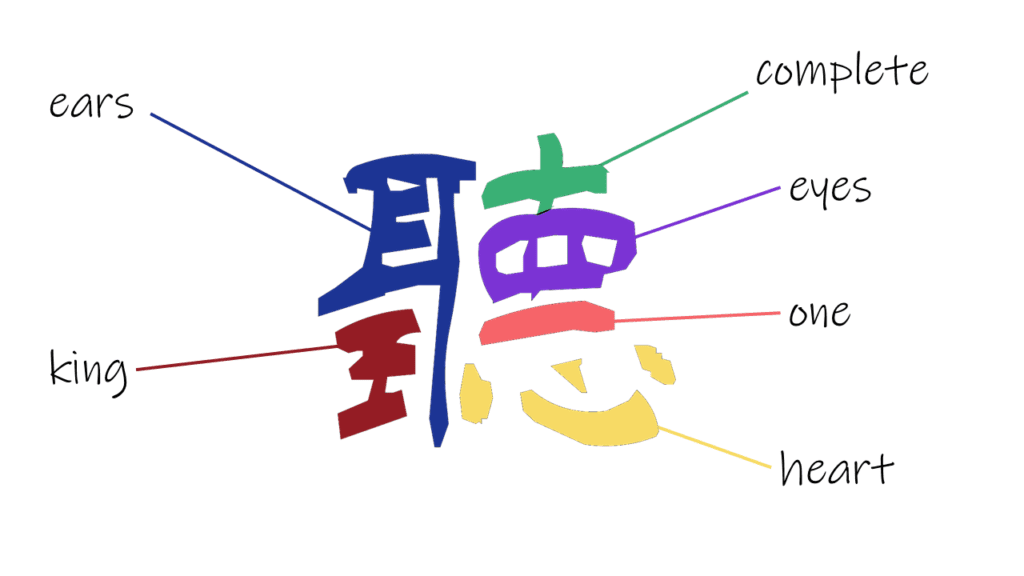
(“聽“ pronounced “ting” ) which literally means “listen” is a phono-semantic compound made up of several distinctive parts, each carrying meaning that represents what we actually “give” when involved in the listening process. As can be seen from the character, the word “耳” which means “ear” is just part of a whole. Listening involves more than auditory perception. Genuine listening happens when instead of saying “I am all ears” we say “I am all present.

Genuine listening means giving our heart (心 – xin)

People come to us, because they need to be understood. Listening to them with empathy could be the greatest gift we will ever give them. Being heard and understood feels good because it is connected to our deepest sense of self-worth. Listening to someone with empathy means caring and acknowledging.

Empathetic listening can’t unfold when we are overwhelmed by worries. The golden rule is to be self-aware and to never get into a conversation when we’re not emotionally prepared. Any attempt to get into a conversation when we don’t feel like it will come across insincere and can’t be concealed.

Listening with empathy gives the other person a chance to unfold as they are and to fully express themselves. This meaning is conveyed by the character (心 pronounced “xin” meaning“Heart”).

“The most basic of human need is to understand and be understood. The best way to understand people is to listen to them.”- Ralph Nichols

Genuine listening means maintaining eye-contact (目)

When engaged in a conversation, words represent a fraction of the meaning that is conveyed. A lot more information is transmitted nonverbally. Albert Mehrabian, a pioneer researcher of body language in the 1950’s, found that the total impact of a message is about 7 percent verbal, 38 percent vocal and 55 percent nonverbal. Since then, many researchers have replicated his research and found consistent results.

Respectful eye-contact is the agent that dissolves the boundary between the verbal and nonverbal. It brings a pure quality of receptivity as it opens the window to content and context of the message. Rid yourself of all visual distractions, open the window to your soul to person talking to you. This is the meaning of the “eyes” part of the Chinese character “目”(pronounced “mu”) which literally means “eyes.”

Listening means giving your undivided attention as you would a king (王)

When was the last time you gave your undivided attention to someone you were talking to? The challenge here is to bring our full attention to the person whom we are talking to. Listening with undivided attention means do away with external distractions as well as with internal distractions.

Oftentimes we listen with our attention focused on how we are going to respond or refute what the other person is saying. Genuine listening is different, it involves listening with curiosity, compassion, and with the true purpose of understanding. Imagine being invited to a royal feast. Treat the other person as a king, your guest of honor, because they are. This is what these Chinese characters mean (pronounced “yi” meaning “one,” and 王 pronounced, “wang” meaning “king”).

“Hearing is listening to what is said. Listening is hearing what isn’t said.” – Simon Sinek

Genuine listening assumes everyone is whole ( )

The evidence of fingerprinting conveys an important truth that seems to elude us most of the time: each of us is unique. There are no “two” individuals with the same fingerprint. If we hold this simple fact upfront, we shall become more tolerant. We shall stop using our perceptual filters to judge others when difference of opinions emerges.

We become fully appreciative of the other, understanding that their uniqueness and wholeness are to be celebrated. This new paradigm shift will allow us to be whole again, and consequently make those around us feel the same. After all, if you see yourself as an individual worthy of being understood for who you are, why not do the same to others? This is the meaning conveyed by the last Chinese character 十 (shi), which means complete.

Imagine a world where everyone felt heard and understood. Wouldn’t you want to live in a such a world? I would! May these simple yet powerfully transformative principles inspire you to help create a culture built around empathy and love.

Image courtesy of Twenty20.com


from
https://addicted2success.com/life/the-anatomy-of-genuine-listening-from-a-traditional-chinese-character/

Wednesday, 19 December 2018

Don’t Change All Your Habits — Just Change One.

3 Ways You Can Evolve Into Your Bigger and Braver Self

Look at your dog, he or she is the cutest animal ever, always happy, that plays with his squeaky toys, and cries when you come back home. Now, think about a wild wolf. A playful mate for puppies, but ready to transform into a lethal predator. With a look capable of petrifying any other living being who sees it pass by, wolves are intimidating, fierce, and tough as hell.

Not the description of an animal that you can pet near the fireplace, right? This comparison is useful because it gives the opportunity to think about the reason for the substantial difference between a domestic and a wild animal.

Why is that useful to us?

While our dog spends his life playing and sleeping on soft, warm pillows with his belly full, the wolf can be often found starving while trudging in the snow and squinting against the wind, battling the cold, right in the middle of a days-long hunt.

Those experiences forge the mind and the body of the animal. The same thing is also valid for humans. If we live an extremely comfortable life we become the domestic dog, otherwise, if we are exposed to hard situations throughout our lives, we become the wild wolf.

Comfort feels really good in the moment, but it’s terrible in the long term because it doesn’t prepare us to face the difficulties that life inevitably will throw at us. Discomfort forces us to face issues that once seemed too much to bear, and face them with more confidence because we’ve become aware of our ability to endure hard times.

It’s crucial to intentionally choose to withstand daily, minor adversities, without waiting to be caught unprepared by the unplanned ones, because, by doing so, we’re forced to evolve and become more resilient.

“All the adversity I’ve had in my life, all my troubles and obstacles, have strengthened me… You may not realize it when it happens, but a kick in the teeth may be the best thing in the world for you.” – Walt Disney

Below are three habits that can help you transform into the biggest and bravest wolf:

1. Exercise

Exercise, if done correctly, is a great way to make yourself tougher. Push through the fatigue and finish that high-intensity session, or get that last rep in. This isn’t about injuring yourself, it’s about becoming aware of where your limits are.

The retired Navy SEAL David Goggins has conceptualized the 40% rule, in which he states that once your mind tells you “you’re done”, you’re really only 40% done. So when you feel that you can’t do that last set of burpees, shake it off, put your hands on the ground, and do it.

2. Have a cold shower

The hot water handle is right there, and it would be easy to turn it and have a nice warm shower, but don’t do it. Stay strong! The feeling of ice cold water running down your spine isn’t a pleasurable sensation, but it’s only that, a sensation, it won’t kill you.

Start with ten seconds and then, slowly, increase the time you spend under the cold water. The cold shower also increases alertness, speeds muscle recovery, relieves depression, and improves circulation.

3. Read stoic philosophy

Stoicism teaches the development of self-control and courage as a means of overcoming destructive emotions and the hardships that life will inevitably throw at us. Reading some books of the most well-known stoic philosophers turns out to be extremely useful to learn how to strengthen our minds.

Can it be done wrong? Of course! We can sustain a lot more struggles than what we think, but there is a limit to the amount of suffering that we can tolerate, and above that, it becomes detrimental.

To avoid this situation, we should operate on that thin edge. We have to discover it with experience, but after we’ve realized where that point is, we need to push ourselves there.

Consider it similar to what happens when we lift weights. Strength improves when you lift enough weight. When you lift too little, you don’t gain anything, and if you lift too much, you risk injuries.

“Discipline is the bridge between goals and accomplishment.” – Jim Rohn

And what happens when life strikes?

Naturally, when life hits, it isn’t in our power to decide how strong the punch will be. We simply have to stay strong and keep moving forward through the pain and the struggles.

However, resisting the storm is easier if we’ve toughened our will and trained our bodies during the quiet times. So, consider implementing some form of daily challenge, and use it as preparation for the difficult times that will come.

While the dog, under the rain and the blowing wind, trembles from the cold and shakes from the fear, the wolf puts his head down and continues to walk, knowing to be strong enough to endure, until the sun rises again.

How do you persevere when times are tough? Let us know some of your tips below!


from
https://addicted2success.com/life/3-ways-you-can-evolve-into-your-bigger-and-braver-self/

Tuesday, 18 December 2018

Success is for the Self-Taught

Truman Capote, Jimi Hendrix, Steve Jobs, Nikola Tesla. Those are four names you never thought you’d see in a sentence together. As it happens, these four individuals have more in common than their success, ingenuity, and fame. They were all autodidacts. In other words, they were self-taught learners.

The talents and innovations that skyrocketed them to fame were the products of their own teachings. Make no mistake, this doesn’t mean a formal education is a waste of time. However, it goes to show that success is crafted solely by commitment and focus. While college and traineeships can prepare us for the groundwork of what we pursue, it’s ultimately up to us as individuals to teach ourselves how to refine our knowledge for success.

It’s the self-taught principles that allow us to distinguish our own work from that of others. With the help of the internet, self-taught success is more possible than ever. And there are plenty of ways to reach our inner autodidact.

Elon Musk had science degrees from top Ivy League universities, but he still credits most of his knowledge to the textbooks he allegedly “committed to memory.” Reading is just one way to teach yourself everything you need to know. Aspiring inventors can surely learn a lot by sacrificing some of their leisure time to sit down with a textbook.

For writers and artists, the best study is to just read. Read anything. Inspiration can be derived from poetry, works of fiction, etc. These also help you develop your writing skills, which is an important asset for any aspiring entrepreneur.

“Self-education is, I firmly believe, the only kind of education there is.” – Isaac Asimov

With the help of online Master Classes, Youtube videos, and apps – where online courses developed by some of the top U.S. educational institutions can be accessed remotely – self-taught success is more attainable than ever.

What’s more, we learn through practice. We can publish our own eBooks through Amazon without the publishing house bureaucracy. We can advertise our product, brand, or service through social media savvy without astronomical advertising costs. And as we practice, we learn. We gain feedback from our followers, learn from our mistakes, and do it better the second time around.

Even when you’re teaching yourself, others are always helping. However, you get to decide which lessons are most constructive, and you get to apply them to the real world in real-time.

The Science of Self-Taught

People have a tendency to romanticize the concept of self-taught success. It’s not a solution for laziness, or an excuse for lack of motivation. In many cases, teaching yourself is more work than being taught. The level of accountability rises when you are both teacher and student. Furthermore, it requires more discipline. Without a structured schedule or a guaranteed reward at the end of your efforts, your only hope is your dedication.

Beyond this, however, the only thing stopping most people from teaching themselves is insecurity. Fear of failure and inadequacy halts self-taught learners in their tracks. Especially because with self-teaching, inevitably, comes occasional failure. Unfortunately, the self-taught often feel they have nobody to blame the failure on but themselves – no teachers, mentors, or trainers as scapegoats.

According to Psychology Today, there is nothing that makes certain people better self-taught learners than others. The only difference is motivation, and willingness to overcome that lingering insecurity. Even the concept of “learning styles” is erroneous, says Psychology Today. While each individual is different, ability to learn is not based on preference, but expertise.

Beginners learn better from examples, while experts learn better by solving problems. This builds yet another case for autodidacts, who are more likely to learn by experience – the most effective method.

“Wisdom is not a product of schooling but a lifelong attempt to acquire it.” – Albert Einstein

The Rewards of Being Self-Taught

The fruits of your labor taste sweeter when you’ve taught yourself how to grow them. As such, success is more enjoyable when your self-education has contributed to it. All successful individuals have something in common: they’ve taken the initiative to teach themselves new things, or to supplement their formal education with self-teaching, as well.

Therefore, not all groundbreaking inventors, artists, and philosophers are solely self-taught. However, they’ve still accompanied their college training with their own individual quest for knowledge.

There is a simple reason why autodidacts thrive the most: because they’re always learning. The one mistake people who solely rely on formal education and training make is the mistake of stopping their learning process altogether once it’s over. Not only does this prevent you from being up-to-date on the latest concepts and advancements in your field, but it obstructs your brain’s thirst for mental stimulation.

By constantly learning and teaching ourselves new things, no matter how small or large they might be, we could change the course of our overall health and well-being. Research even shows that mental stimulation (consisting of practicing memorization, learning new things, and improving our skill in existing hobbies) is key to slowing down the development of, and possibly even reversing, Alzheimer’s and dementia.

Motivational speaker and entrepreneur Jim Rohn was noted for saying, “Formal education will make you a living; self-education will make you a fortune.” This does not mean you should abandon the pursuit of formal education, as it often serves as the foundation for self-education. But, it does mean we should maintain, cater to, and quench our thirst for knowledge as much as we possibly can.


from
https://addicted2success.com/success-advice/success-is-for-the-self-taught/

Monday, 17 December 2018

80 Albert Einstein Quotes to Inspire You For Life

Albert Einstein is recognized around the world as one of the most iconic and intelligent minds ever.  From his fantastic scientific discoveries, to the hardships he endured during his life; Einstein shared a lot of wisdom and insight on life, people, and the world in general

Here are 80 of Albert Einstein‘s most insightful quotes:

1. “The important thing is not to stop questioning. Curiosity has its own reason for existing.”– Albert Einstein

2. “Weakness of attitude becomes weakness of character.” – Albert Einstein

3. “Truth is what stands the test of experience.” – Albert Einstein

4. “Common sense is nothing more than a deposit of prejudices laid down in the mind before you reach eighteen.” – Albert Einstein

5. “The only source of knowledge is experience.” – Albert Einstein

6. “Any man who reads too much and uses his own brain too little falls into lazy habits of thinking.” – Albert Einstein

7. “There comes a time when the mind takes a higher plane of knowledge but can never prove how it got there.” – Albert Einstein

8. “Everybody is a genius. But if you judge a fish by its ability to climb a tree, it will live its whole life believing that it is stupid.” – Albert Einstein

9. “We cannot solve our problems with the same thinking we used when we created them.” – Albert Einstein

10. “Human beings must have action; and they will make it if they cannot find it.” – Albert Einstein

11. “Education is what remains after one has forgotten what one has learned in school.” – Albert Einstein

12. “If A is a success in life, then A equals X plus Y plus Z. Work is X; Y is play, and Z is keeping your mouth shut.” – Albert Einstein

13. “Everything should be made as simple as possible, but not simpler.” – Albert Einstein

14. “Learn from yesterday, live for today, hope for tomorrow. The important thing is not to stop questioning.” – Albert Einstein

15. “Anyone who has never made a mistake has never tried anything new.” – Albert Einstein

16. “I think and think for months and years. Ninety-nine times, the conclusion is false. The hundredth time I am right.” – Albert Einstein

17. “Unthinking respect for authority is the greatest enemy of truth.” – Albert Einstein

18. “Only a life lived for others is a life worthwhile.” – Albert Einstein

19. “Imagination is everything. It is the preview of life’s coming attractions.” – Albert Einstein

20. “The most incomprehensible thing about the world is that it is comprehensible.” – Albert Einstein

21. “To raise new questions, new possibilities, to regard old problems from a new angle, requires creative imagination and marks real advance in science.” – Albert Einstein

22. “Look deep into nature, and then you will understand everything better.” – Albert Einstein

23. “Peace cannot be kept by force. It can only be achieved by understanding.” – Albert Einstein

24. “Life is like riding a bicycle. To keep your balance you must keep moving.” – Albert Einstein

25. “Small is the number of people who see with their eyes and think with their minds.” – Albert Einstein

26. “Any intelligent fool can make things bigger and more complex… It takes a touch of genius – and a lot of courage to move in the opposite direction.” – Albert Einstein

27. “There are two ways to live: you can live as if nothing is a miracle; you can live as if everything is a miracle.” – Albert Einstein

28. “Great spirits have always encountered violent opposition from mediocre minds. The mediocre mind is incapable of understanding the man who refuses to bow blindly to conventional prejudices and chooses instead to express his opinions courageously and honestly.” – Albert Einstein

29. “The most beautiful experience we can have is the mysterious. It is the fundamental emotion that stands at the cradle of true art and true science.” – Albert Einstein

30. “The difference between genius and stupidity is that genius has its limits.” – Albert Einstein

31. “Information is not knowledge.” – Albert Einstein

32. “No problem can be solved from the same level of consciousness that created it.” – Albert Einstein

33. “It is the supreme art of the teacher to awaken joy in creative expression and knowledge.”– Albert Einstein

34. “Once you stop learning, you start dying.” – Albert Einstein

35. “Imagination is more important than knowledge. For knowledge is limited, whereas imagination embraces the entire world, stimulating progress, giving birth to evolution.” – Albert Einstein

36. “There are only two ways to live your life. One is as though nothing is a miracle. The other is as though everything is a miracle.” – Albert Einstein

37. “Without deep reflection one knows from daily life that one exists for other people.” – Albert Einstein

38. “Try not to become a man of success, but rather try to become a man of value.” – Albert Einstein

39. “Nothing truly valuable arises from ambition or from a mere sense of duty; it stems rather from love and devotion towards men and towards objective things.” – Albert Einstein

40. “All that is valuable in human society depends upon the opportunity for development accorded the individual.” – Albert Einstein

41. “No amount of experimentation can ever prove me right; a single experiment can prove me wrong.” – Albert Einstein

42. “If you can’t explain it simply, you don’t understand it well enough.” – Albert Einstein

43. “You ask me if I keep a notebook to record my great ideas. I’ve only ever had one.” – Albert Einstein

44. “A happy man is too satisfied with the present to dwell too much on the future.” – Albert Einstein

45. “The true sign of intelligence is not knowledge but imagination.” – Albert Einstein

46. “Insanity: doing the same thing over and over again and expecting different results.” – Albert Einstein

47. “I have no special talent. I am only passionately curious.” – Albert Einstein

48. “It’s not that I’m so smart, it’s just that I stay with problems longer.” – Albert Einstein

49. “Anger dwells only in the bosom of fools.” – Albert Einstein

50. “The only way to escape the corruptible effect of praise is to go on working.” – Albert Einstein

51. “The monotony and solitude of a quiet life stimulates the creative mind.” – Albert Einstein

52. “Pure mathematics is, in its way, the poetry of logical ideas.” – Albert Einstein

53. “A human being is part of a whole called by us the universe.” – Albert Einstein

54. “Sometimes one pays most for the things one gets for nothing.” – Albert Einstein

55. “A man should look for what is, and not for what he thinks should be.” – Albert Einstein

56. “Two things are infinite: the universe and human stupidity; and I’m not sure about the universe.” – Albert Einstein

57. “A person who never made a mistake never tried anything new.” – Albert Einstein

58. “Few people are capable of expressing with equanimity opinions which differ from the prejudices of their social environment. Most people are even incapable of forming such opinions.” – Albert Einstein

59. “In order to form an immaculate member of a flock of sheep one must, above all, be a sheep.” – Albert Einstein

60. “The secret to creativity is knowing how to hide your sources.” – Albert Einstein

61. “We can’t solve problems by using the same kind of thinking we used when we created them.” – Albert Einstein

62. “I never think of the future. It comes soon enough.” – Albert Einstein

63. “The value of a man should be seen in what he gives and not in what he is able to receive.”– Albert Einstein

64. “Most teachers waste their time by asking questions that are intended to discover what a pupil does not know, whereas the true art of questioning is to discover what the pupil does know or is capable of knowing.” – Albert Einstein

65. “Few are those who see with their own eyes and feel with their own hearts.” – Albert Einstein

66. “As a human being, one has been endowed with just enough intelligence to be able to see clearly how utterly inadequate that intelligence is when confronted with what exists.” – Albert Einstein

67. “Once we accept our limits, we go beyond them.” – Albert Einstein

68. “I very rarely think in words at all. A thought comes, and I may try to express it in words afterwards.” – Albert Einstein

69. “In the middle of difficulty lies opportunity.” – Albert Einstein

70. “Memory is deceptive because it is colored by today’s events.” – Albert Einstein

71. “Whoever is careless with the truth in small matters cannot be trusted with important matters.” – Albert Einstein

72. “I’d rather be an optimist and a fool than a pessimist and right.”– Albert Einstein

73. “The world as we have created it is a process of our thinking. It cannot be changed without changing our thinking.”– Albert Einstein

74. “Nothing happens until something moves.”– Albert Einstein

75. “If you want your children to be intelligent, read them fairy tales. If you want them to be more intelligent, read them more fairy tales.”– Albert Einstein

76. “I speak to everyone in the same way, whether he is the garbage man or the president of the university.”– Albert Einstein

77. “A table, a chair, a bowl of fruit and a violin; what else does a man need to be happy?”– Albert Einstein

78. “Only those who attempt the absurd can achieve the impossible.”– Albert Einstein

79. “A clever person solves a problem. A wise person avoids it.”– Albert Einstein

80. “A true genius admits that he/she knows nothing.”– Albert Einstein

Which quote resonated with you the most? Comment below!


from
https://addicted2success.com/quotes/80-albert-einstein-quotes-to-inspire-you-for-life/